

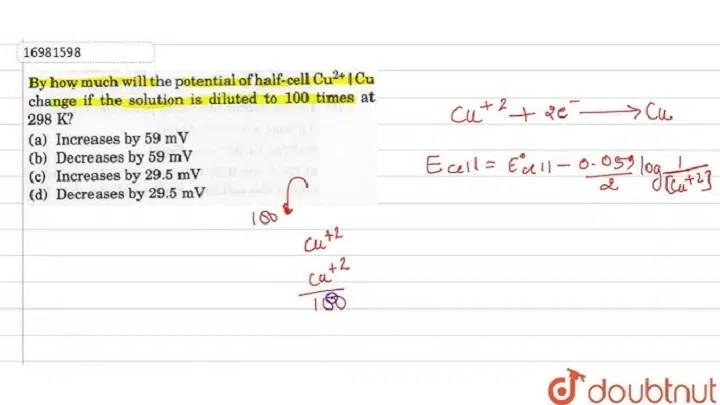
In electrochemistry, a Cu²⁺/Cu electrode (copper ion/copper metal) is a standard half-cell used in redox reactions. When the concentration of Cu²⁺ ions in this electrode is diluted 100 times, it affects the electrode potential directly due to its dependence on ion concentration.
Understanding the Cu²⁺/Cu Electrode
This half-cell reaction is:
Cu2++2e−→Cu(s)\text{Cu}^{2+} + 2e^- \rightarrow \text{Cu(s)}Cu2++2e−→Cu(s)
Standard electrode potential (E⁰) for Cu²⁺/Cu = +0.34 V
What Happens When Diluted 100 Times?
1. Decrease in Cu²⁺ Concentration
- Original concentration: let’s say 1 M
- After 100× dilution: 0.01 M (10⁻² M)
2. Use the Nernst Equation
E=E0−0.0591nlog(1[Cu2+])E = E^0 – \frac{0.0591}{n} \log \left( \frac{1}{[\text{Cu}^{2+}]} \right)E=E0−n0.0591log([Cu2+]1)
Where:
- E0=+0.34 VE^0 = +0.34 \, \text{V}E0=+0.34V
- n=2n = 2n=2 (number of electrons)
- [Cu2+]=0.01 M[\text{Cu}^{2+}] = 0.01 \, \text{M}[Cu2+]=0.01M
E=0.34−0.05912log(10.01)E = 0.34 – \frac{0.0591}{2} \log \left( \frac{1}{0.01} \right)E=0.34−20.0591log(0.011) E=0.34−0.02955×log(100)E = 0.34 – 0.02955 \times \log(100)E=0.34−0.02955×log(100) E=0.34−0.02955×2=0.34−0.0591=∗∗0.2809 V∗∗E = 0.34 – 0.02955 \times 2 = 0.34 – 0.0591 = **0.2809 \, \text{V}**E=0.34−0.02955×2=0.34−0.0591=∗∗0.2809V∗∗
✅ Final Answer:
After dilution, the new electrode potential is approximately +0.28 V.
Key Takeaways
- Diluting the Cu²⁺ concentration lowers the electrode potential.
- The more dilute the ions, the less positive the potential becomes.
- This impacts the cell voltage when connected in a galvanic cell.
💡 Tip: Always use the Nernst equation for non-standard conditions when the ion concentration changes!